LOS ANGELES UNITED METHODIST MUSEUM OF SOCIAL JUSTICE
  • Home
  • About
    • Board of Directors
    • Museum & Education Partners
    • Get Involved
  • Board of Advisors
  • Exhibitions
    • Comrade Sisters: Women of the Black Panther Party
    • Future Exhibitions
    • Past Exhibitions >
      • That Stubborn Resistance
      • Hope and Dignity: The Farmworker Movement
      • "Comfort Women" Then and Now: Who They Were and Why We Should Remember Them
      • Finding Sequins in the Rubble: Archives of Jotería Memories in Los Angeles
      • La Plaza: A Center of Injustice and Transformation
      • Ink Tributes
      • Deported Veterans
      • Caravanas del Diablo
      • Thai El Monte Garment Workers >
        • Quilting Project
      • New Black City
      • Impact on Innocence >
        • Lies by Deborah McDuff
      • One of Us: How We See It
      • Transportapueblos: The Resilientes
      • Visualizing the People's History
      • Goodwill: Its Founding and History in Southern California
      • Greyhound Diaries
      • One of Us
      • California Dream: A Community Response
      • In Memoriam: Los Angeles
      • Shattered Mural
      • Con Safos: Reflections of Life in the Barrio
      • African American Civil Rights Movement L.A. Exhibition
      • Exodus
  • Support/Membership
  • Visit
  • Supporters
  • Educational Tools and Resources
  • Historical Archive
  • Allyship and Support
    • BLM Resources for Kids
  • Tardeada 2022
  • Tardeada 2021
  • Tardeada 2020
  • Contact
  • Link Page

NEWS & EVENTS 

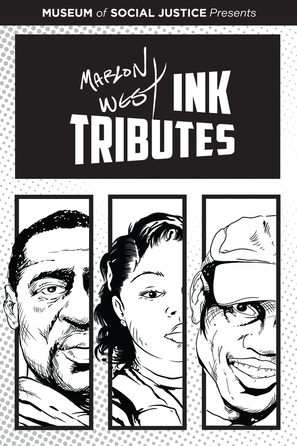
OPENING OF MARLON WEST INK TRIBUTES

8/9/2022

1 Comment

 
Marlon West Ink Tributes opens August 13, 2022 with the opening reception at 4:00 p.m.

Marlon West of Disney Animation was content to make photo tableaus of action figures as a silly creative outlet between Zoom meetings and housework during Covid lockdown. That came to a crashing halt with the murder of George Floyd, when he started these comic-book-style tributes. He says, “For many of us Black nerds, Marvel’s characters are particularly relatable. They are often hated and hunted by the powers that be. There isn’t a more American form of portraiture than black 'inks’ over white, to honor those that faced this nation’s fear and loathing of the Black body.”


Opening reception RSVP: bit.ly/InkTributesOpening
Picture
1 Comment

L'ŒIL DE LA PHOTOGRAPHIE Feature

5/10/2022

0 Comments

 
Museum of Social Justice: Joseph Silva: Deported Veterans
ANDY ROMANOFF, L'ŒIL DE LA PHOTOGRAPHIE
MAY 2, 2022
Los Angeles is a big city, five hundred square miles of endless neighborhoods seemingly without a center. Fifty years ago, new in town, I struggled to grasp this gigantic place without much success. One night I was telling this to a friend when he gave me a thought I still hold on to. The heart of Los Angeles, he told me, is a little plaza near downtown called El Pueblo de Los Angeles. It dates back to the earliest settlers and everything else is newer and radiates out from it. “Go and stand in the plaza,” he said, “close your eyes and you can feel the city all around you.” So I went, and stood with closed eyes and the feeling slowly grew in me that I was standing at the calm center of the city. There may have been drugs involved that night but for me ever since, Olvera Street and the plaza down at the end have been the heart of L.A. Sitting here still calms me and resets my senses.

The Museum of Social Justice is located on the edge of the plaza, in a small space down some stairs at the corner of a large building, the United Methodist Church. The museum calls attention to often overlooked issues and right now it is calling attention to the immigrants who served in the United States military, risked their lives to keep us safe, but then later run afoul of the law. Unprotected by citizenship they have been thrown out of the country they fought
to protect.

Joseph Silva is a U.S. Navy Veteran and a Documentary Fine Art Photographer. He spent six years exploring this story, traveling to Mexico, the Caribbean, Central America and Europe to photograph the veterans this country has turned away. The Soldier’s Creed: “You don’t leave your shipmate on the beach, leave no man behind” drove him to tell the story. In his personal statement about the work Silva says, “My journey started in the spring of 2016 while photographing Donald Trump protesters in downtown San Diego. I started to hear stories about deported veterans, so I sent a message to Hector Barajas, a US Army veteran deported to Tijuana, Mexico. I told him I wanted to cross the border to hear his story. A couple days later I took a Leica M4, M3, and a checked-out Canon 7D from the Santa 2/3 Monica College student newspaper. I met Hector at the BUNKER, the Deported Veterans Support House in Tijuana, Mexico. After arriving at the BUNKER and meeting Hector and fellow Veterans, I felt like I was at a VRC (veteran resource center) on a college campus shooting the shit …. I knew within 20 minutes after being in their presence that I had to tell their stories.”

​Silva’s work fills hundreds of rolls of film and multiple hard drives and the pictures on display here attest to his vision and his passion. But the story he tells is a complex one, one that the photographs alone cannot reveal, so each picture is accompanied by a short text that gives you a name and a glimpse into the person pictured. The combination of words and pictures tells a sobering story. Moving slowly in the quiet room, seeing them and learning little bits
about these strangers, I found the pictures and text together illuminated their lives, and knowing their names brought them even closer.

For the record, this exhibit is not a simple one-dimensional story. Some of these soldiers have adapted to life in their new countries and would be happy just to come once in a while and visit friends and family left behind; others want the birthright they believe they have earned, but all feel that something is fundamentally wrong with the way they have been treated.
​
So once again, I found myself in the plaza at the  at the heart of Los Angeles. This time I gained an understanding of a story I hadn’t thought about and saw an exhibition worth seeing. If you have the chance I suggest you come down here too. You can spend some time looking at Joseph Silva’s fine photos and then you can stand in the plaza at the center of Los Angeles, feel yourself in the middle of it all, and think for yourself about what ought to be done.

0 Comments

APRIL 2021

4/8/2021

0 Comments

 
Picture

Coretta Scott King
April 27, 1927 to January 30, 2006 

Remembered as “the First Lady of the Civil Rights Movement” Coretta Scott King was not only the wife of Dr. Martin Luther King Jr. but a leader in her own right. From the start of the movement King made an effort to include more women in positions of power and to simply take part in the development of the country for the better. After the assassination of her husband in 1958, King became the de-facto leader where she expanded the demands of the Civil Rights movement to include LGBT rights. She is also the responsible for making Martin Luther King Day a national holiday. She used her own inspirations to ensure that her husband's memory would live on as a cause for improvement within the United States. She was a pacifist and often used her platform to advocate for world peace, and during the Vietnam War, she advocated for its end. 

George Takei
April 20, 1937 to Present 

Best known for his role in the hit TV Series Star Trek, Takei has become a more active voice for social movements in the last two decades. During his long and rewarding career as an actor Takei kept his sexuality private and only revealed it to the public in 2005. From then on, he used his notoriety to fight for LGBT rights and condemned racism in the United States. Over the last decade he has used every opportunity to expose injustices to the LGBT community. This includes but is not limited to posting funny quips on Twitter directed at the last administration to highlight a misdeed. In this regard, Takei has served the community as an activist that people could put their trust behind earning him many awards for his activism including the LGBT Humanist Award.          

Garry Kasparov
April 13, 1963 to Present 

Grandmaster Kasparov is better known in the United States amongst chess players for his tactical skills and knowledge of this ancient and well-known game among the global community. However, having lived through the end of the USSR and the rise of its current political regime under Vladimir Putin, Kasparov has had concerns with the political nature of his native Russia since his youth. He became disillusioned with the Communist party that had ruled his nation since 1922 (the 1917 government being more of a transitional government) at the age of thirteen when he had traveled to Paris for an international chess competition. This trip gave him a shock about how different nations granted their citizens political freedoms, such as freedom of speech and other liberties that his own at the time did not grant, not to mention past atrocities under Stalin. Kasparov is still acting as a political advocate for his fellow countrymen and for better global relations between the nations. He has participated in many demonstrations that included the likes of Alexey Navalny and Yevgeniya Chirikova. In 2011 he was made chairmen of The Human Rights Foundation, using his position to not only point out the wrongs of his native Russia but her close allies that have also committed human rights violations. His book Winter is Coming: Why Vladimir Putin and the Enemies of the Free World Must Be Stopped (2015) is one of his many writings on his political ideologies and concerns. 
0 Comments
<<Previous

    EVENTS & NEWS


    Categories

    All

    Archives

    August 2022
    May 2022
    April 2021
    March 2021
    February 2021
    January 2021
    November 2020
    October 2020
    September 2020
    August 2020
    July 2020
    June 2020
    May 2020
    April 2020
    March 2020
    February 2020
    January 2020
    December 2019
    October 2019
    September 2019
    August 2019
    July 2019
    June 2019
    May 2019
    April 2019
    March 2019
    February 2019
    January 2019
    December 2018
    November 2018
    October 2018
    September 2018
    August 2018
    June 2018
    May 2018
    March 2018
    February 2018
    January 2018
    December 2017
    November 2017
    October 2017

    RSS Feed

LET’S STAY IN TOUCH

115 Paseo de La Plaza | Los Angeles | CA 90012
Copyright  2013–2025 Museum of Social Justice | Los Angeles ​
  • Home
  • About
    • Board of Directors
    • Museum & Education Partners
    • Get Involved
  • Board of Advisors
  • Exhibitions
    • Comrade Sisters: Women of the Black Panther Party
    • Future Exhibitions
    • Past Exhibitions >
      • That Stubborn Resistance
      • Hope and Dignity: The Farmworker Movement
      • "Comfort Women" Then and Now: Who They Were and Why We Should Remember Them
      • Finding Sequins in the Rubble: Archives of Jotería Memories in Los Angeles
      • La Plaza: A Center of Injustice and Transformation
      • Ink Tributes
      • Deported Veterans
      • Caravanas del Diablo
      • Thai El Monte Garment Workers >
        • Quilting Project
      • New Black City
      • Impact on Innocence >
        • Lies by Deborah McDuff
      • One of Us: How We See It
      • Transportapueblos: The Resilientes
      • Visualizing the People's History
      • Goodwill: Its Founding and History in Southern California
      • Greyhound Diaries
      • One of Us
      • California Dream: A Community Response
      • In Memoriam: Los Angeles
      • Shattered Mural
      • Con Safos: Reflections of Life in the Barrio
      • African American Civil Rights Movement L.A. Exhibition
      • Exodus
  • Support/Membership
  • Visit
  • Supporters
  • Educational Tools and Resources
  • Historical Archive
  • Allyship and Support
    • BLM Resources for Kids
  • Tardeada 2022
  • Tardeada 2021
  • Tardeada 2020
  • Contact
  • Link Page