LOS ANGELES UNITED METHODIST MUSEUM OF SOCIAL JUSTICE
  • Home
  • About
    • Board of Directors
    • Museum & Education Partners
    • Get Involved
  • Board of Advisors
  • Exhibitions
    • Comrade Sisters: Women of the Black Panther Party
    • Future Exhibitions
    • Past Exhibitions >
      • That Stubborn Resistance
      • Hope and Dignity: The Farmworker Movement
      • "Comfort Women" Then and Now: Who They Were and Why We Should Remember Them
      • Finding Sequins in the Rubble: Archives of Jotería Memories in Los Angeles
      • La Plaza: A Center of Injustice and Transformation
      • Ink Tributes
      • Deported Veterans
      • Caravanas del Diablo
      • Thai El Monte Garment Workers >
        • Quilting Project
      • New Black City
      • Impact on Innocence >
        • Lies by Deborah McDuff
      • One of Us: How We See It
      • Transportapueblos: The Resilientes
      • Visualizing the People's History
      • Goodwill: Its Founding and History in Southern California
      • Greyhound Diaries
      • One of Us
      • California Dream: A Community Response
      • In Memoriam: Los Angeles
      • Shattered Mural
      • Con Safos: Reflections of Life in the Barrio
      • African American Civil Rights Movement L.A. Exhibition
      • Exodus
  • Support/Membership
  • Visit
  • Supporters
  • Educational Tools and Resources
  • Historical Archive
  • Allyship and Support
    • BLM Resources for Kids
  • Tardeada 2022
  • Tardeada 2021
  • Tardeada 2020
  • Contact
  • Link Page

NEWS & EVENTS 

JULY 2020

7/2/2020

0 Comments

 
Picture

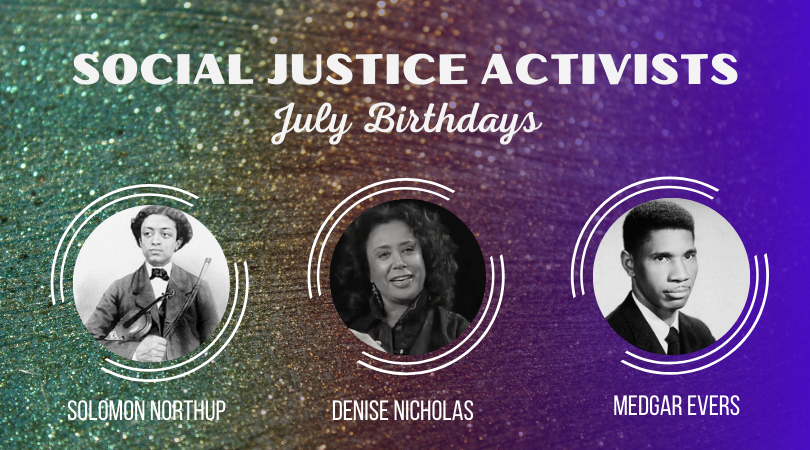
​Solomon Northup
​July 10, 1807 to 1863

 An abolitionist whose memoir, 12 Years A Slave, inspired the 2013 film of the same name. Solomon Northup’s life and experience shows that the crime of slavery in the United States was a danger to anyone of African descent. Born free in the state of New York, he spent much of his life as a farmer and inspiring violinist until he was drugged and sold into slavery while in rout to Washington D.C. (at the time the Nation's biggest slave market) where he was offered a job to perform. After his kidnapping he was sent to New Orleans and spent twelve years in Louisiana as a slave. He was sold to William Prince Ford, then to John M. Tibaut (who Northup disliked the most), and lastly to Edwin Epps for ten years. During his time at the Epps plantation, Northup encountered Samuel Brass, a Canadian man who gained his trust and helped in his freedom. After being freed Northup spent the rest of his life campaigning for the end of slavery in the United States leaving behind his memoir that become a contribution to the abolitionist movement. His memoirs are praised for their detail and brutal honesty. While Northup did not live to see the end of slavery in the United States his works and story still lives on and have been used as examples of the harshness of the slave trade in the United States amongst other struggles facing people of African descent. 

Denise Nicholas
​July 12, 1944 to Present

An American actor and writer, Denise Nicholas has spent much of her life as an activist join acting companies that catered to rural African Americans in the hopes of providing the experience of live performances to these communities. Such companies including the Free Southern Theater and the Negro Ensemble Company. While she would gain international fame for her performance in the series Room 222, she never stopped advocating for social justice. In 2005, she published her first novel Freshwater Road that used the Civil Rights Movement as a backdrop with some of her experiences also being an influence. While she is not currently active in the current entertainment industry her legacy lives on through her novel. 

Medgar Evers
July 2, 1925 to July 12, 1963 

A student of considerable degree and a veteran of the Second World War, Medgar Evers lived in one of the worst states in the south during the period of Jim Crow and pre-Civil Rights reforms. Born and raised in Mississippi, Evers spent much of his life jeered and prodded by the socially accepted racist behavior of the state. Being forced to go to a school further away than where he lived, he was often exposed to the cruelty of the social divide between Black and white Americans, mostly conducted school peers. After serving in the Second World War, Evers started to take a more active role in dismantling racist practices in his state by joining the Regional Council of Negro Leadership (RCNL) were his leadership would shove him to the for front of the growing Civil Rights Movement. One of the biggest protests that he led and organized was against the University of Mississippi, which rejected him on the grounds of his race. The University of Mississippi faced backlash on an international level from the work of Evers and his allies. Unfortunately, Evers did not live to see the fruits of his and many others’ labors when he was assassinated in the wake of President Kennedy’s civil rights address. While not as well-known as Dr. Martin Luther King, Medgar Evers is still remembered to this day as a strong leader in his state of Mississippi.   
0 Comments


Leave a Reply.

    EVENTS & NEWS


    Categories

    All

    Archives

    August 2022
    May 2022
    April 2021
    March 2021
    February 2021
    January 2021
    November 2020
    October 2020
    September 2020
    August 2020
    July 2020
    June 2020
    May 2020
    April 2020
    March 2020
    February 2020
    January 2020
    December 2019
    October 2019
    September 2019
    August 2019
    July 2019
    June 2019
    May 2019
    April 2019
    March 2019
    February 2019
    January 2019
    December 2018
    November 2018
    October 2018
    September 2018
    August 2018
    June 2018
    May 2018
    March 2018
    February 2018
    January 2018
    December 2017
    November 2017
    October 2017

    RSS Feed

LET’S STAY IN TOUCH

115 Paseo de La Plaza | Los Angeles | CA 90012
Copyright  2013–2025 Museum of Social Justice | Los Angeles ​
  • Home
  • About
    • Board of Directors
    • Museum & Education Partners
    • Get Involved
  • Board of Advisors
  • Exhibitions
    • Comrade Sisters: Women of the Black Panther Party
    • Future Exhibitions
    • Past Exhibitions >
      • That Stubborn Resistance
      • Hope and Dignity: The Farmworker Movement
      • "Comfort Women" Then and Now: Who They Were and Why We Should Remember Them
      • Finding Sequins in the Rubble: Archives of Jotería Memories in Los Angeles
      • La Plaza: A Center of Injustice and Transformation
      • Ink Tributes
      • Deported Veterans
      • Caravanas del Diablo
      • Thai El Monte Garment Workers >
        • Quilting Project
      • New Black City
      • Impact on Innocence >
        • Lies by Deborah McDuff
      • One of Us: How We See It
      • Transportapueblos: The Resilientes
      • Visualizing the People's History
      • Goodwill: Its Founding and History in Southern California
      • Greyhound Diaries
      • One of Us
      • California Dream: A Community Response
      • In Memoriam: Los Angeles
      • Shattered Mural
      • Con Safos: Reflections of Life in the Barrio
      • African American Civil Rights Movement L.A. Exhibition
      • Exodus
  • Support/Membership
  • Visit
  • Supporters
  • Educational Tools and Resources
  • Historical Archive
  • Allyship and Support
    • BLM Resources for Kids
  • Tardeada 2022
  • Tardeada 2021
  • Tardeada 2020
  • Contact
  • Link Page