LOS ANGELES UNITED METHODIST MUSEUM OF SOCIAL JUSTICE
  • Home
  • About
    • Board of Directors
    • Museum & Education Partners
    • Get Involved
  • Board of Advisors
  • Exhibitions
    • Comrade Sisters: Women of the Black Panther Party
    • Future Exhibitions
    • Past Exhibitions >
      • That Stubborn Resistance
      • Hope and Dignity: The Farmworker Movement
      • "Comfort Women" Then and Now: Who They Were and Why We Should Remember Them
      • Finding Sequins in the Rubble: Archives of Jotería Memories in Los Angeles
      • La Plaza: A Center of Injustice and Transformation
      • Ink Tributes
      • Deported Veterans
      • Caravanas del Diablo
      • Thai El Monte Garment Workers >
        • Quilting Project
      • New Black City
      • Impact on Innocence >
        • Lies by Deborah McDuff
      • One of Us: How We See It
      • Transportapueblos: The Resilientes
      • Visualizing the People's History
      • Goodwill: Its Founding and History in Southern California
      • Greyhound Diaries
      • One of Us
      • California Dream: A Community Response
      • In Memoriam: Los Angeles
      • Shattered Mural
      • Con Safos: Reflections of Life in the Barrio
      • African American Civil Rights Movement L.A. Exhibition
      • Exodus
  • Support/Membership
  • Visit
  • Supporters
  • Educational Tools and Resources
  • Historical Archive
  • Allyship and Support
    • BLM Resources for Kids
  • Tardeada 2022
  • Tardeada 2021
  • Tardeada 2020
  • Contact
  • Link Page

NEWS & EVENTS 

March 2019 Birthdays

3/1/2019

0 Comments

 
Picture

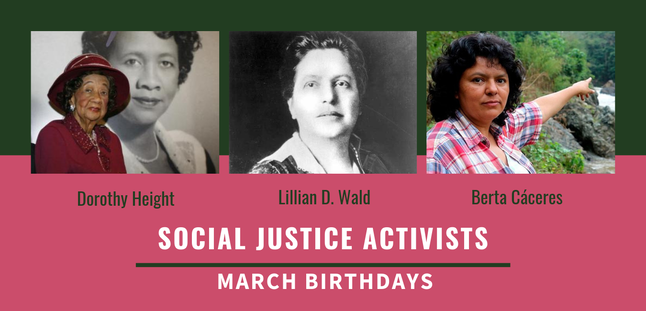
Dorothy Height​
March 24, 1912 – April 20, 2010 

Dorothy Height was an educator and social activist in civil rights and women’s rights, focusing on the issues of African-American women, including illiteracy, voter awareness, and unemployment. Her activism career began in high school where she participated in anti-lynching campaigns. She received her bachelor degree master’s degree in educational psychology from New York University and pursued postgraduate work at Columbia University. During the Depression Era, Height worked as caseworker for New York City Welfare Department and soon began her civil rights career, joining the National Council of Negro Women, fighting for equal rights of both African-Americans and women. In 1957, she was appointed the president of the National Council of Negro Women, holding the position for 40 years. During the Civil Rights Movement, Height created “Wednesdays in Mississippi,” which brought black and white women from the North and South together to share a dialogue of understanding. Additionally, she was a founding member of the Council for the United Civil Rights Leadership. Height severed as council for many American leaders, including First Lady Eleanor Roosevelt, President Dwight D. Eisenhower, who she encouraged to desegregate schools, and too encouraged President Lyndon B. Johnson to appoint African-American women in positions in government. For her long commitment to civil rights and the rights of women, Dorothy Height was awarded the Presidential Medal of Freedom in 1994 and the Congressional Gold Medal in 2004. Her funeral service at Washington National Cemetery was attend by President Barack Obama, First Lady Michelle Obama, as well as by many other leaders, dignitaries and nobility.

Lillian D. Wald
March 10, 1867 – September 1, 1940

Lillian Wald was an American nurse, humanitarian, and author, who worked to ensure that women, children, immigrants, the poor, and all people of different ethnicities and religions would be able to live the American promise of “life, liberty, and the pursuit of happiness.”  She grew up in Ohio and New York, where she became a nurse. Wald hoped that as a nurse she would be able to provide decent heath care to those outside the hospital and in poor and middle-class communities, such as those who lived in the Lower East Side tenements, where she served as a “public health nurse.” In 1895, she founded the Henry Street Settlement House after witnessing firsthand the poor healthcare conditions women and children were living in. Henry Street continues today as a non-profit agency providing social services, arts programs and health care services to New Yorkers of all ages in the Lower East Side neighborhood of Manhattan, New York. Wald advocated for nurses in public schools, for the rights of women and minorities. She campaigned for suffrage and was supported racial integration. At Henry Street she employed not only women, but all men and women of all racial and ethnic groups. She made sure that Henry Street was racially integrated, as well as created Stillman House, which served the African-American community.  Wald’s most notable work for civil rights was her institutional involvement with the National Negro Conference at Henry Street, which became the founding meeting of the National Association for the Advancement of Colored People.

Berta Cáceres
March 4, 1971 – March 3, 2016

,Berta Cáceres was a Honduran/Lenca environmental activist and indigenous leader who co-founded the Consejo Cívico de Organizaciones Indígenas Populares – COPINH (Civic Council of Popular Indigenous Organisations), which led fierce campaigns against megaprojects in 1993. Growing up in the 1970s during a time of civil unrest and violence in Central America, Cáceres’ mother Austra Bertha Flores Lopez served as her role model. She was a midwife and social activist who took in and cared for refugees from El Salvador, as well as elected as the mayor of their hometown La Esperanza, as congresswoman, and the governor of the Department of Intibucá. Throughout her activism Cáceres faced and often won against illegal logger, plantation owners, multinational corporatio19ns, and dam projects that would cut off food and water supplies to indigenous communities. Her biggest win was against Agua Zarca Dam, a joint project of Honduran company Desarrollos Energéticos SA (DESA) and Chinese state-owned Sinohydro, the world’s largest dam developer.  Her fight for the environment and for the rights of her Lenca people and all indigenous people of Honduras brought threats of violence against her life. These threats continued until her death when she was killed by unknown assailants in her home in La Esperanza, Honduras on March 3, 2016. Her death was followed by the killing of her two of her colleagues. In 2012, Cáceres was awarded the Shalom Award by the Society for Justice and Peace at the Catholic University of Eichstätt-Ingolstadt, she was nominated as a finalist for the 2014 Front Line Defenders Prize (2014), and in 2015, she was awarded the Goldman Environmental Prize.
0 Comments


Leave a Reply.

    EVENTS & NEWS


    Categories

    All

    Archives

    August 2022
    May 2022
    April 2021
    March 2021
    February 2021
    January 2021
    November 2020
    October 2020
    September 2020
    August 2020
    July 2020
    June 2020
    May 2020
    April 2020
    March 2020
    February 2020
    January 2020
    December 2019
    October 2019
    September 2019
    August 2019
    July 2019
    June 2019
    May 2019
    April 2019
    March 2019
    February 2019
    January 2019
    December 2018
    November 2018
    October 2018
    September 2018
    August 2018
    June 2018
    May 2018
    March 2018
    February 2018
    January 2018
    December 2017
    November 2017
    October 2017

    RSS Feed

LET’S STAY IN TOUCH

115 Paseo de La Plaza | Los Angeles | CA 90012
Copyright  2013–2025 Museum of Social Justice | Los Angeles ​
  • Home
  • About
    • Board of Directors
    • Museum & Education Partners
    • Get Involved
  • Board of Advisors
  • Exhibitions
    • Comrade Sisters: Women of the Black Panther Party
    • Future Exhibitions
    • Past Exhibitions >
      • That Stubborn Resistance
      • Hope and Dignity: The Farmworker Movement
      • "Comfort Women" Then and Now: Who They Were and Why We Should Remember Them
      • Finding Sequins in the Rubble: Archives of Jotería Memories in Los Angeles
      • La Plaza: A Center of Injustice and Transformation
      • Ink Tributes
      • Deported Veterans
      • Caravanas del Diablo
      • Thai El Monte Garment Workers >
        • Quilting Project
      • New Black City
      • Impact on Innocence >
        • Lies by Deborah McDuff
      • One of Us: How We See It
      • Transportapueblos: The Resilientes
      • Visualizing the People's History
      • Goodwill: Its Founding and History in Southern California
      • Greyhound Diaries
      • One of Us
      • California Dream: A Community Response
      • In Memoriam: Los Angeles
      • Shattered Mural
      • Con Safos: Reflections of Life in the Barrio
      • African American Civil Rights Movement L.A. Exhibition
      • Exodus
  • Support/Membership
  • Visit
  • Supporters
  • Educational Tools and Resources
  • Historical Archive
  • Allyship and Support
    • BLM Resources for Kids
  • Tardeada 2022
  • Tardeada 2021
  • Tardeada 2020
  • Contact
  • Link Page