LOS ANGELES UNITED METHODIST MUSEUM OF SOCIAL JUSTICE
  • Home
  • About
    • Board of Directors
    • Museum & Education Partners
    • Get Involved
  • Board of Advisors
  • Exhibitions
    • Comrade Sisters: Women of the Black Panther Party
    • Future Exhibitions
    • Past Exhibitions >
      • That Stubborn Resistance
      • Hope and Dignity: The Farmworker Movement
      • "Comfort Women" Then and Now: Who They Were and Why We Should Remember Them
      • Finding Sequins in the Rubble: Archives of Jotería Memories in Los Angeles
      • La Plaza: A Center of Injustice and Transformation
      • Ink Tributes
      • Deported Veterans
      • Caravanas del Diablo
      • Thai El Monte Garment Workers >
        • Quilting Project
      • New Black City
      • Impact on Innocence >
        • Lies by Deborah McDuff
      • One of Us: How We See It
      • Transportapueblos: The Resilientes
      • Visualizing the People's History
      • Goodwill: Its Founding and History in Southern California
      • Greyhound Diaries
      • One of Us
      • California Dream: A Community Response
      • In Memoriam: Los Angeles
      • Shattered Mural
      • Con Safos: Reflections of Life in the Barrio
      • African American Civil Rights Movement L.A. Exhibition
      • Exodus
  • Support/Membership
  • Visit
  • Supporters
  • Educational Tools and Resources
  • Historical Archive
  • Allyship and Support
    • BLM Resources for Kids
  • Tardeada 2022
  • Tardeada 2021
  • Tardeada 2020
  • Contact
  • Link Page

NEWS & EVENTS 

November 2018 Birthdays

11/1/2018

0 Comments

 
Picture

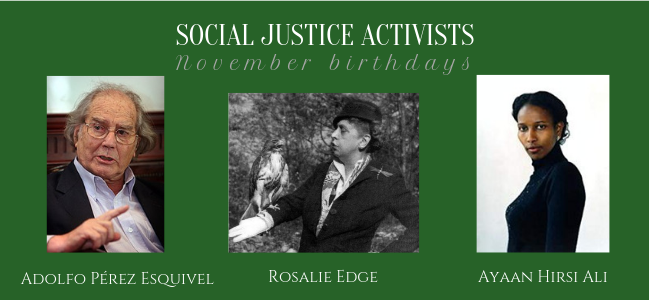
​Adolfo Pérez Esquivel 
​ November 26, 1931

A painter, sculptor, architect, and activist Adolfo Pérez Esquivel was born in Buenos Aires, Argentina, to a Spanish fisherman who immigrated to Argentina from Poio, Galicia. His mother passed away when he was three and he grew up in extreme poverty, however despite this, he did well in school and attended the Manuel Belgrano School of Fine Arts and the National University of La Plata, where he trained as a painter and sculptor. He experienced a successful career as a sculptor, which granted him recognition. Following this he had an equally successful career as a teacher for 25 years teaching sculpture from primary schools to universities.  During the 1960s, Pérez Esquivel began working with Latin America Christian pacifist groups, and in 1968 he formed a joint organization covering all non-violent elements throughout Latin America. In 1974, he co-founded the NGO Servicio Paz y Justicia (Service, Peace and Justice Foundation or SERPAJ), played a great role in promoting an international campaign to denounce the atrocities committed by the military regime. Being dedicated to the peace movement, Pérez Esquivel’s outspoken and courageous approach earned him many enemies, which found him detained by the Brazilian Military Police in 1975, jailed with Latin American and North American bishops in Ecuador in 1976, and detained and tortured by the Argentine Federal Police in 1977. On December 10, 1980, Pérez Esquivel was awarded the Nobel Peace Prize for his efforts in the defense of human rights. 

Rosalie Edge
November 3, 1877 - November 20, 1962

A women’s rights and environment activist was born in New York City, to wealthy socialite parents. In 1913, during one of her Trans-Atlantic trips, Edge meet Sybil Margaret Thomas (a.k.a. Lady Rhondda) a prominent British women’s suffrage activists who taught Edge about the lacks of rights women had under men. This encounter affected Edge greatly and she immediately joined the women’s suffrage movement, where she became the member of the Equal Franchise Society to learn the basics of politics, to deliver speeches, and take part in debates. Subsequently, she was appointed the secretary-treasurer of the New York State Woman Suffrage Party, significantly helping in the enactment of the 19th Amendment of the United States Constitution in 1920, giving women the right to vote. After this victory, Edge turned her focus to wildlife and conservation. She took particular interest in bird watching and compiled a list of over 800 species of birds. After learning that the National Association of Audubon Societies (NAAS), a wildlife conservation organization was allowing hunting to take place on their land, Edge founded the Emergency Conservation Committee, which published numerous pamphlets questioning the work of various wildlife protection organizations. As founder and lifelong member of the association, Edge continuously fought for stronger measures to protect bird species and for creating laws that stressed humans to protect the wildlife and nature. In 1933, coming across photos of dying hawks in the Kittatinny Mountains of eastern Pennsylvania, Edge campaigned for a year to purchase the land, and in 1934 she did so, finding the Hawk Mountain Sanctuary, the world’s first refuge for birds of prey. It still continuous to save birds, conduct research and run educational programs. Rosalie Edge remained the president of the Hawk Mountain Sanctuary until the day she died. 

Ayaan Hirsi Ali
November 13, 1969

Ayaan Hirsi Ali is a Somali-born Dutch activist and feminist. The daughter of Hirsi Magan Isse, a well-known politician in Somalia's opposition party, Ali moved a lot before settling in Kenya with her family. In 1992, she sought and received political asylum in the Netherlands. In 2000, upon receiving her master’s degree in Political Science, she began her political career with the Netherlands’ Labor Party, as a researcher on immigration issues. In 2002, she changed political parties and began her work with the Liberal’s People’s Party for Freedom and Democracy. She was elected to the lower house of the Dutch Parliament in 2003, where she became known for her outspoken stance on the treatment of women in Islam, as well as, attacking  Dutch immigration policy towards Muslims. In 2004, partnering with director Theo Van Gogh, Ali took her activism mainstream with a documentary entitled Submission, which highlighted the ways Islam supported the abuse of women. The documentary came with danger and grave results. Van Gogh was stabbed to death and upon his body a note threatening Ali’s life was found. In 2006, she traveled to the United States for the first time to promote her novel The Caged Virgin, highlighting her firsthand experience of the familial abuse endured by Muslim women, making it significant as the first anti-Islam works written by an Islamic women. She published her second Infidel and founded the Ayaan Hirsi Ali Foundation in Philadelphia in 2007. The organization's mission is to help western Islamic women escape abuse. Her third novel Nomad was published in 2010, and although a best-seller has caused Ali much opposition from Western Muslims. Ayaan Hirsi Ali has received numerous awards for her work on human rights. She received the Freedom Prize in Denmark (2004) for work on women’s rights, the Harriet Freezerring Emancipation prize (2005) by the magazine Opzij, the European Bellwether prize in Norway (2005) for her work on human rights, and the Anisfield-Wolf book award for her autobiography, Infidel (2008). 
0 Comments


Leave a Reply.

    EVENTS & NEWS


    Categories

    All

    Archives

    August 2022
    May 2022
    April 2021
    March 2021
    February 2021
    January 2021
    November 2020
    October 2020
    September 2020
    August 2020
    July 2020
    June 2020
    May 2020
    April 2020
    March 2020
    February 2020
    January 2020
    December 2019
    October 2019
    September 2019
    August 2019
    July 2019
    June 2019
    May 2019
    April 2019
    March 2019
    February 2019
    January 2019
    December 2018
    November 2018
    October 2018
    September 2018
    August 2018
    June 2018
    May 2018
    March 2018
    February 2018
    January 2018
    December 2017
    November 2017
    October 2017

    RSS Feed

LET’S STAY IN TOUCH

115 Paseo de La Plaza | Los Angeles | CA 90012
Copyright  2013–2025 Museum of Social Justice | Los Angeles ​
  • Home
  • About
    • Board of Directors
    • Museum & Education Partners
    • Get Involved
  • Board of Advisors
  • Exhibitions
    • Comrade Sisters: Women of the Black Panther Party
    • Future Exhibitions
    • Past Exhibitions >
      • That Stubborn Resistance
      • Hope and Dignity: The Farmworker Movement
      • "Comfort Women" Then and Now: Who They Were and Why We Should Remember Them
      • Finding Sequins in the Rubble: Archives of Jotería Memories in Los Angeles
      • La Plaza: A Center of Injustice and Transformation
      • Ink Tributes
      • Deported Veterans
      • Caravanas del Diablo
      • Thai El Monte Garment Workers >
        • Quilting Project
      • New Black City
      • Impact on Innocence >
        • Lies by Deborah McDuff
      • One of Us: How We See It
      • Transportapueblos: The Resilientes
      • Visualizing the People's History
      • Goodwill: Its Founding and History in Southern California
      • Greyhound Diaries
      • One of Us
      • California Dream: A Community Response
      • In Memoriam: Los Angeles
      • Shattered Mural
      • Con Safos: Reflections of Life in the Barrio
      • African American Civil Rights Movement L.A. Exhibition
      • Exodus
  • Support/Membership
  • Visit
  • Supporters
  • Educational Tools and Resources
  • Historical Archive
  • Allyship and Support
    • BLM Resources for Kids
  • Tardeada 2022
  • Tardeada 2021
  • Tardeada 2020
  • Contact
  • Link Page